
Ten issuepages,live fast,backed by search.
Designed pages. Search campaigns behind them.
Approved policy language became pages voters could scan and campaigns that could respond to the queries voters actually used.
Steyer for Governor
Approved policy language became pages voters could scan and campaigns that could respond to the queries voters actually used.
Traditional team is at Approved ad copy. Patronage loop is at Approved policy copy.
Issue pages need speed and substance.
A statewide campaign runs on issues - housing, gas prices, healthcare, education, climate, and whatever the news cycle adds next week. Each one needs its own page, but a page that is actually designed takes days: structure, visuals, resources, review, CMS work, QA. Under that pressure, most campaigns ship the simple version - approved policy text pasted into a CMS. The page exists, but it is not designed around what voters search for, watch, scan, or share.
Designed pages, not policy dumps.
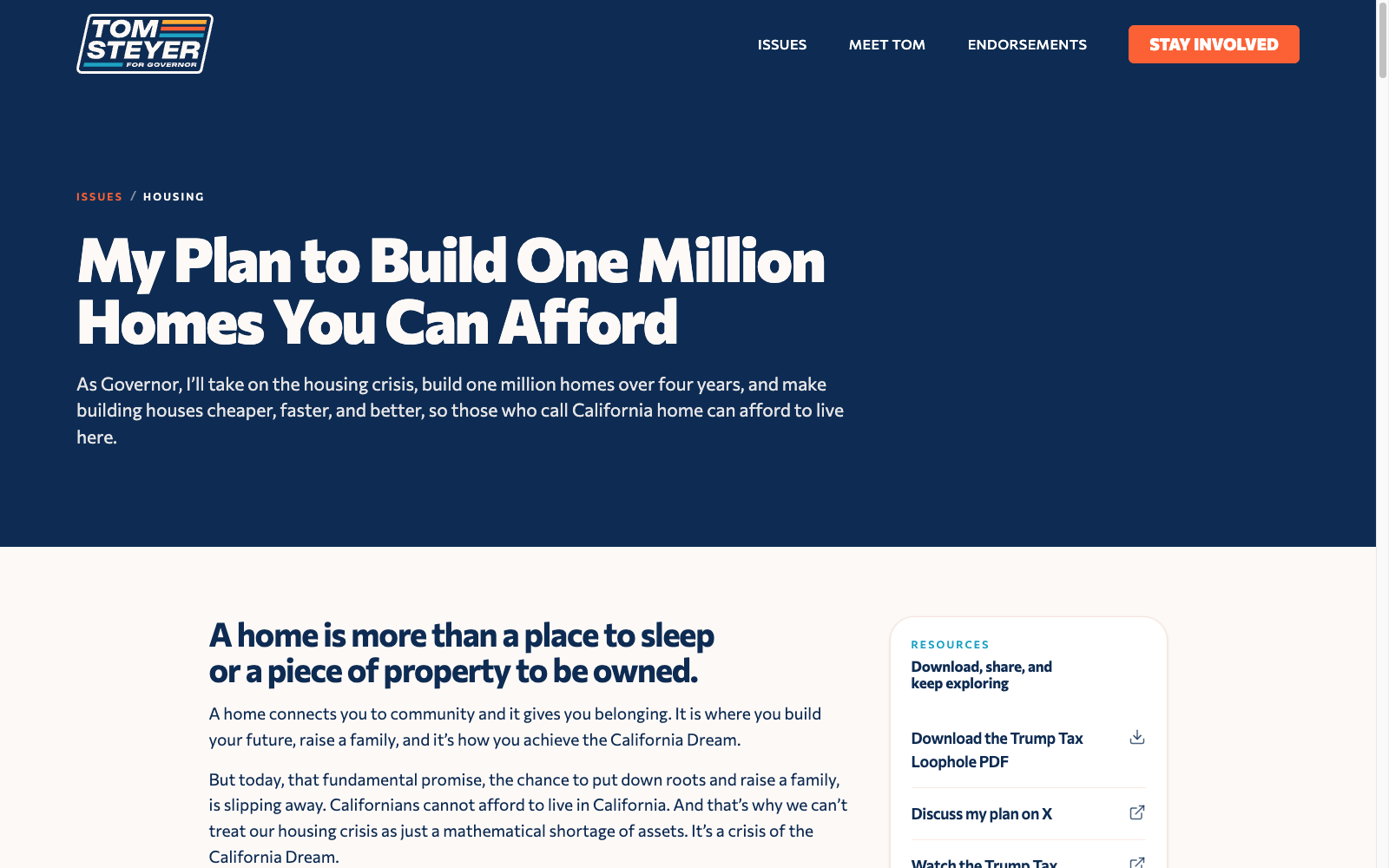
The housing page went from scoped brief to a live, CMS-backed page in a day. Speed mattered, but the bigger shift was the quality of the output: approved policy text became a designed page with a hero, issue-focus sections, a video carousel, and inline calls to action instead of one undifferentiated column. A script pulled related YouTube videos for each issue so the page had motion and context, turning a static policy statement into something a voter could watch, scan, and follow.
Built around how voters search.
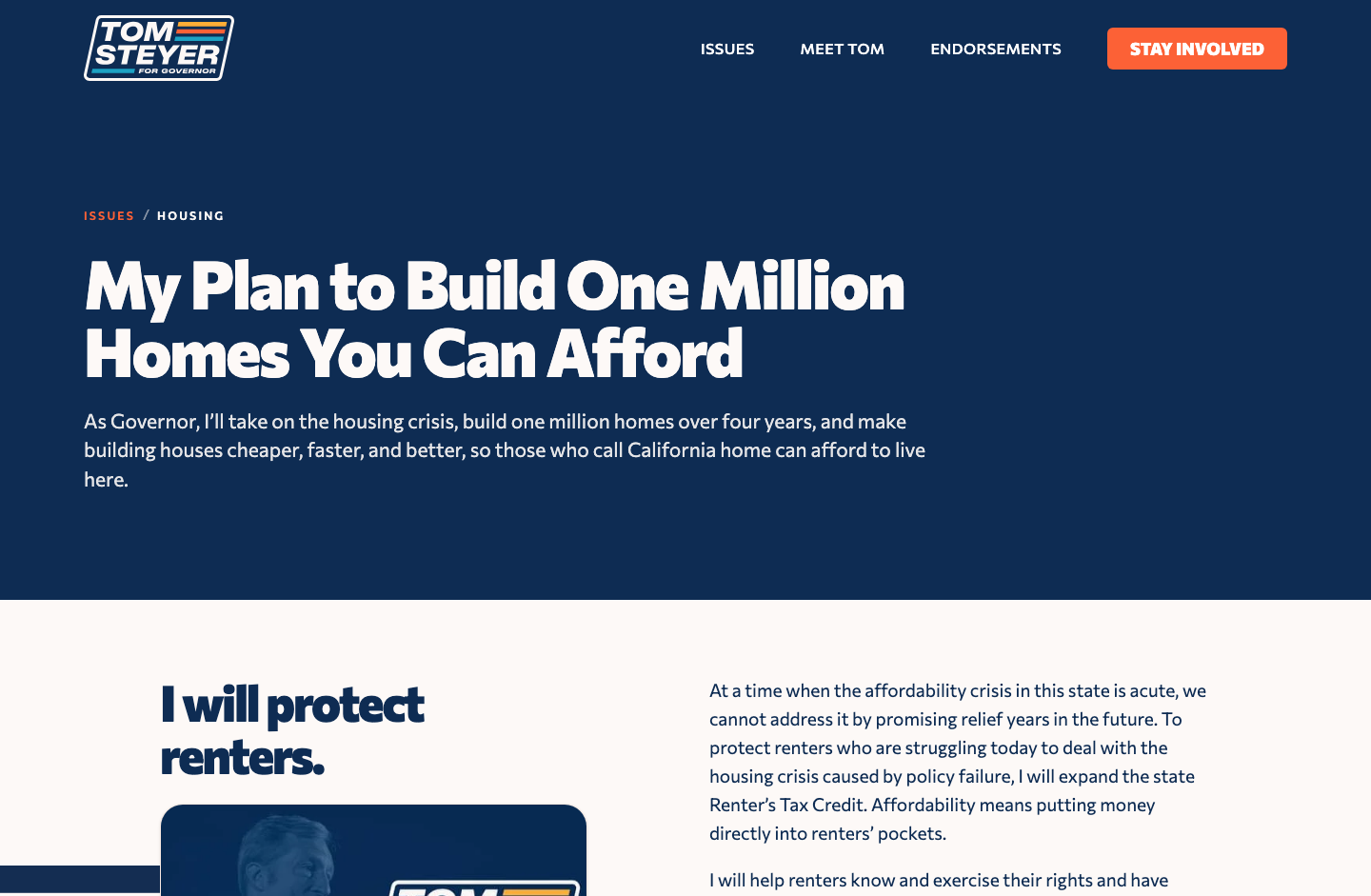
The issue-focus sections were not just layout - each one answered a specific search intent. The renters focus is the cleanest example: voters were not searching for "housing policy architecture." They were searching for rent control, tenant rights, eviction rules, rent increases, and renter protection. The paid campaign grouped those questions together and sent them to ?focus=renters, where the page opened on the relevant policy highlight instead of asking the voter to hunt for it.
| Renters query group | Example keywords | Est. monthly volume | Landing focus |
| Rent control | california rent control | 1,400 | ?focus=renters |
| Tenant rights | california tenant rights, california renters rights | 1,900 | ?focus=renters |
| Eviction and rent increases | california eviction laws, california rent increase | 750 | ?focus=renters |
| High-intent long tail | renters tax credit california, california tenant protection act, just cause eviction california | Low volume, high intent | ?focus=renters |
In month one, the Renter Protection ad group produced 20,543 impressions, 887 clicks, and 561 engagement conversions. The lesson was not just that renters searched. It was that search behavior showed exactly where copy needed to get more practical and less legalistic.
Detailed search campaigns, built from approved language.
Because the page was built from approved language, the paid campaign could be too. The vet-copy step traced every headline and description back to the page - 88 lines, zero unapproved - so a deeply segmented search campaign came together from pre-approved text with minimal new review, not a fresh legal pass on every line. Ninety-nine negative keywords (58 campaign-level, 41 per ad group) filtered navigational and bargain-hunting queries before they spent a dollar.
There was no time to earn organic rankings, so the campaign bought the intent instead - informational queries like "why are gas prices so high in California," cheap because few advertisers compete for them and dense with exactly the voters an issue page exists to inform. The bar was not the cheapest click; it was an engaged visit - ten seconds or more reading the policy. As search terms came in, the campaign had a reviewable path for tightening negatives, deep links, and copy around what voters were actually asking.
| Search campaign layer | What it did | Why it mattered |
| Approved-language source | 88 headlines and descriptions traced back to page copy | Fast launch without message drift |
| Intent-mapped ad groups | Each housing theme matched a page section and ?focus= deep link | Voters landed on the answer the ad promised |
| Negative keyword system | 58 campaign-level and 41 ad-group negatives filtered waste | Spend went toward informational demand, not bargain or navigational searches |
| Engagement bar | Optimization looked for visits with 10+ seconds reading policy | The campaign learned from actual issue interest, not click volume alone |
Fast pages only matter if they can learn.
The win was not just that ten pages shipped. It was that each page had enough design, structure, and channel connection to do useful work in market: answer a voter question, carry a video, land a search ad, and feed the next optimization pass. That is the difference between a campaign ready to shape the conversation and one still waiting on the build.
Search learned, then scaled.
The first week answered the basic question: would voters who came from search stay with the issue page? They did. Week two turned that behavior into an optimization target. After that, the work was scale: more issue pages, tighter negative keywords, and a steady weekly average at a much lower cost per engaged visit.
| Phase | Window | Engaged visits | Engagement efficiency | What it proved |
|---|---|---|---|---|
| Week 1 - initial learning | Mar 25-31 | 1,163 | Baseline | The designed housing page could turn paid search clicks into engaged visits. |
| Week 2 - scaling with optimization | Mar 31-Apr 7 | 2,794 | +66% vs baseline | Once user_engagement became the optimization target, volume more than doubled while efficiency improved. |
| Weeks 3-9 - scaled issue pages and optimization | Apr 7-Jun 2 | 4,900 avg / week | +245% vs baseline | Housing found its efficient baseline, then the five-issue platform held it through search-term and negative-keyword optimization. |
10designed
Housing, taxes, entertainment, electricity, gas prices, education, immigration, climate, healthcare, and AI policy each had a page built for voters to read, watch, and search.
40search
Across the ten issue briefs, search was organized into 40 ad groups so ads, keywords, and landing-page sections could stay aligned by voter intent.
535negative
Across the ten issue campaign briefs, search was mapped with 535 negative-keyword entries. The optimization review also marked 18 low-performing ad groups to pause, turning search-term review into a repeatable cleanup path.
Turn a launch into a page and channel plan.
Bring us the issue, offer, or campaign you need in market. We will map the page, channel, and measurement path in one working session.